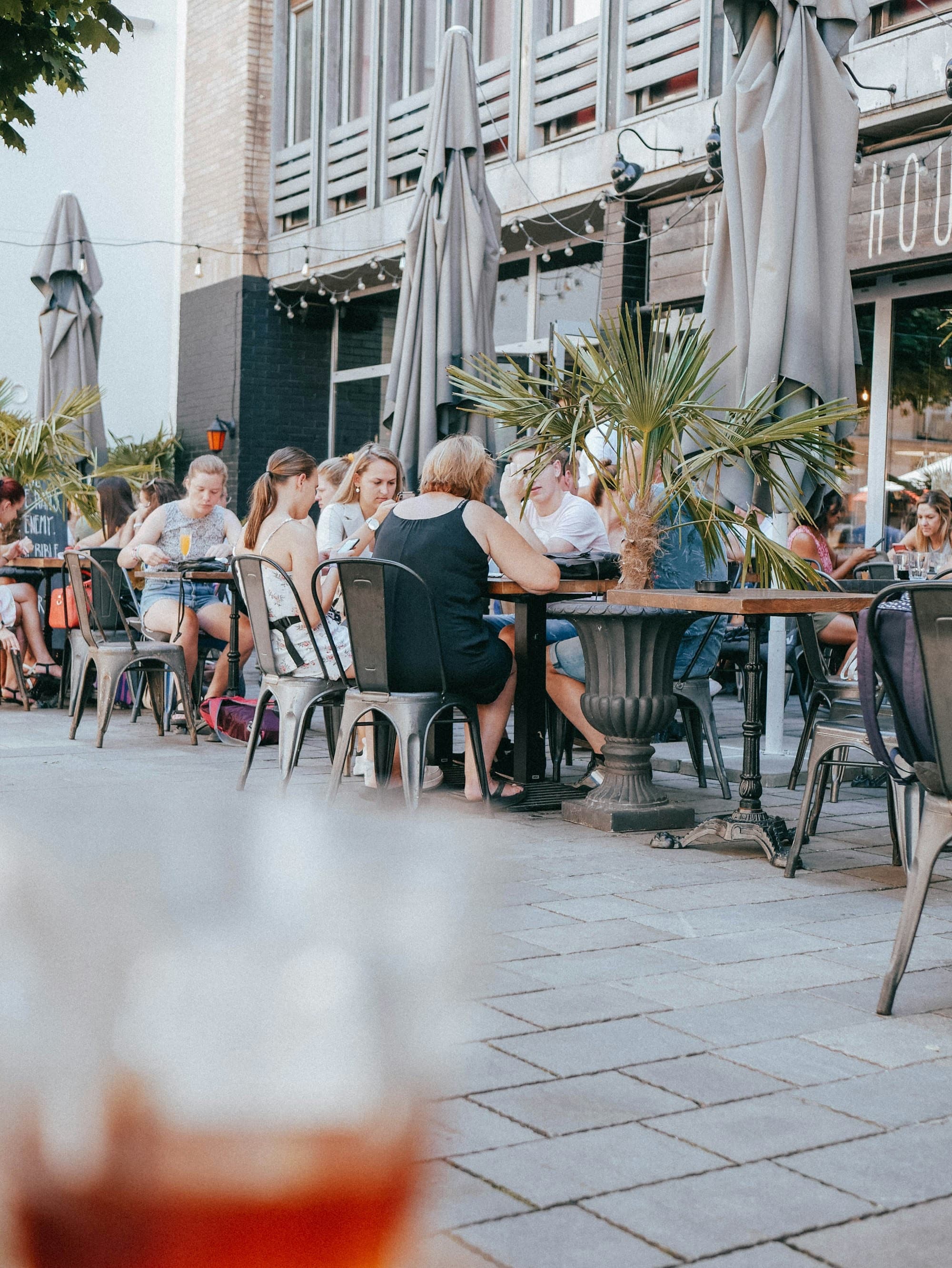
Why guests would rather write than call
A phone call needs two people at the same moment. Your guest wonders on Sunday evening whether there is a table free on Friday; at that hour nobody is standing by your phone. And on Friday at 19:40 it rings in the middle of service, so whoever picks up is not with a guest.
A message asks for none of that. It is written when the guest has a minute and read when you have one. In between, the booking form does the work: it knows your booking times, your tables and your rules, and it only offers what is genuinely free.
Then there is the hurdle itself. Calling means speaking, waiting and spelling out a name. Writing means three lines. Exactly those guests who would rather not call end up booking somewhere else, or not at all.
How a reservation over WhatsApp works
Four steps, and none of them are yours:
- The guest scans your QR code or taps your link and is in a chat with your restaurant.
- They write anything at all. Back comes a short message with a button to your booking form.
- In the form they pick the date, the number of people and the time, exactly as on your website. Only what is really free is offered.
- Seconds later the confirmation is in their WhatsApp, and the reminder arrives at the same place later.
The confirmation email goes out as well, as it always does. A guest who deletes the chat still has it.
What you need for it
A WhatsApp Business account for your restaurant. You connect it in the dashboard under Messages; your link and a printable QR code are waiting there afterwards.
Meta bills the messages straight to you, through your own account. Tavolo adds nothing on top and earns nothing from it.
So that a busy month never turns into a surprise invoice, you set a monthly budget. Once it is reached WhatsApp rests until the next month, and your guests keep getting confirmations and reminders by email.
Where the link belongs
A link is only worth something where a guest sees it. Four places that pay off:
On your website
As a second button next to “Book a table”. Guests who prefer writing will take it.
In Instagram and Google
In your Instagram bio and your Google Business Profile. That is where guests look first.
On the menu and the A‑board
As a QR code on the menu, the A‑board or a business card. The guest at the table books the next visit.
In your phone greeting
On the answering machine and in the call‑back message, for the hours when nobody can pick up.
WhatsApp, Telegram or the form on your website?
The three routes do not rule each other out, they reach different guests. What sets them apart:
| What matters | Telegram | Form on your website | |
|---|---|---|---|
| How many guests use it | Almost everyone. In much of Europe it is the default messenger. | Far fewer, but firmly established among international guests. | Anyone with a browser, but only those who find your site. |
| Where the booking happens | A button in the chat opens your booking form. | The form opens inside the chat itself. | On your own page. |
| What the channel costs | Meta bills every message straight to you. Tavolo adds nothing on top. | Nothing. | Nothing. |
| What you need for it | A WhatsApp Business account and approval from Meta. | A bot for your restaurant. One minute, no review. | One line of code or the WordPress plugin. |
| Confirmation in the same channel | By email. | ||
| Reminder before the booking | By email. | ||
| QR code for menu and A‑board | |||
| Booking appears in the table plan at once |
Both channels can run side by side. See reservations via Telegram
WhatsApp has the widest reach and is the only one with running costs. Telegram costs nothing and is worth having as a second route. The form on your website stays the foundation both of them point to.
What happens in your restaurant after the booking
Nothing extra. The reservation sits in the same table plan as every other one, with table, party size and note, and the guest lands in the guest history. Next time you will know they have been before.
If they write again later, you see it in the dashboard inbox and reply from there. WhatsApp allows free text within 24 hours of the guest's last message and only fixed templates after that. That is Meta's rule, not ours, and Tavolo shows you which window you are in.
Frequently asked questions
Do I need a separate WhatsApp number for the restaurant?
You need a WhatsApp Business account for your restaurant. The number your guests see as the sender belongs to you and stays with you, even if you leave Tavolo again.
What does a message over WhatsApp cost?
Meta sets that and bills you directly through your own WhatsApp Business account. Tavolo adds nothing on top. The monthly budget in the dashboard is your own ceiling.
Can guests write to us freely in the chat?
Yes. Everything guests send to your number appears in the dashboard inbox, and you answer from there. WhatsApp allows free text within 24 hours of the guest's last message, and only fixed templates after that.
Does the guest still get an email?
Yes. The confirmation always goes out by email as well. WhatsApp is an addition, not a replacement.
What happens when the monthly budget is used up?
WhatsApp rests until the next month. Reservations carry on as normal, and confirmations and reminders arrive by email instead. No booking is ever lost because of it.
Is this compatible with the GDPR?
Yes. The guest decides whether to write to you and can leave the chat at any time. Tavolo processes the reservation data as a processor on behalf of your restaurant, and the servers are in Germany.
Does it work without a website of my own?
Yes. The link and the QR code stand on their own. Plenty of restaurants start this way and only embed the form on their site later.
How long does setting it up take?
The Tavolo account is created in a few minutes. For WhatsApp there is the connection of your Business account on top; after that the link is in your dashboard. You can try all of it free for 30 days, without a credit card.
Last updated: September 23, 2026